
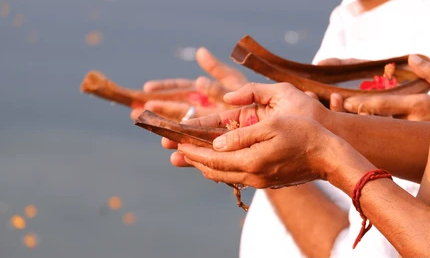
This blog was written on 2 November 2025, the day Mexico celebrates the Day of the Dead.
by Dr. Vivek Desai
Introduction
As Mexico celebrates the Day of the Dead, let us take a moment to reflect on the Bhāratīya concept and practice of tarpaṇa.
Tarpaṇa, derived from the Sanskrit root “tṛp,” meaning “to satisfy” or “to please,” is an ancient Vedic ritual of offering. In it, sacred substances such as water, sesame seeds and other materials are offered with devotion and gratitude to unseen and divine entities — the devas (gods, celestial beings, natural forces), ṛṣis (ancient sages) and pitṛs (ancestors). Through tarpaṇa, we acknowledge the unseen debts we owe to the many forces that are the causes of our creation and sustenance.
The Three Debts of Human Life
According to the Vedas, every human being is born with three sacred debts (ṛṇa):
(1) deva-ṛṇa — debt to the gods
(2) ṛṣi-ṛṇa — debt to the sages
(3) pitṛ-ṛṇa — debt to one’s ancestors
The modern idea of individualism promotes the false belief in an independent personal entity, which, as we see today, leads to psychological issues such as loneliness and depression, social issues such as poverty and broken homes, and environmental issues such as pollution and ecological imbalance. If we pause to observe life carefully — from the daily sunrise and sunset to the rhythm of the seasons — we realize that we do not exist in isolation. Whether it is our body or our personality, both are created and shaped by the sacrifice of many entities, many of them unseen — such as natural elements, ancient sages and our ancestors. Therefore, we owe all these forces a debt, which in Sanskrit is known as ṛṇa. This concept of ṛṇa is essential to understanding life through the lens of Vedic wisdom or Hindu thought.
With the concept of ṛṇa at the center, the purpose of human life is not to seek pleasure but to perform one’s duties diligently in order to repay these debts. The focus, therefore, is not on pleasure but on duty, not on rights but on responsibilities, not on entitlement but on gratitude. Tarpaṇa is an expression of that gratitude — an act of humility, a recognition that we are nourished by nature, born in a lineage and guided by timeless wisdom.
Why do tarpaṇa?
Tarpaṇa is performed to repay these three sacred debts. The scriptures prescribe detailed guidelines for each type of offering — including the posture to assume, the direction to face, the position of the hands, the substances to offer and the mantras to chant. Although the materials offered vary, water is used in all offerings. Water, as even modern science affirms, is the marker of life; thus, it symbolizes life itself. Esoterically, water is known to preserve and carry subtle vibrations — including thoughts — so when it is offered with saṅkalpa (solemn intention), it can bring peace not only to the ancestors but also to the living.
Thus, tarpaṇa becomes more than a ritual — it becomes a meditative act that purifies the mind of selfishness, harmonizes seen and unseen relationships, and brings peace to the land we inhabit.
Why do piṇḍa-dāna?
Piṇḍa-dāna — literally “offering of the (symbolic) body” — is a specific form of pitṛ-tarpaṇa performed for the departed. It is traditionally observed after a person’s death, or during pitṛ-pakṣa or śrāddha (the fortnight of ancestors, observed in the period immediately preceding Śarad Navarātra) and often at sacred pilgrimage places.
The piṇḍa — a ball made of rice, barley, sesame, honey and ghee (clarified butter) — represents the body of the departed. This offering aids the sūkṣma śarīra (subtle body) of the deceased in its onward journey. The family prays for the release of the departed individual from unfulfilled desires and unresolved emotions so that it may attain higher planes of peaceful existence. Traditionally, a crow, regarded to possess subtle vision, is offered food during this ritual. Considered a messenger of the ancestors, the act of feeding the crow symbolizes that the offering has reached and been accepted by them.
Beyond its ritual significance, piṇḍa-dāna reminds us of the sacred cycle of birth and death — and that love lies in the courage to let go, even of our most beloved, when it is time for them to move on. True love frees; it does not bind.
Conclusion
The rituals of tarpaṇa and piṇḍa-dāna are not mechanical observances of the past; they are living practices with the power to transform our present and our future. Engaging in these rituals with devotion imparts experiential knowledge that life is a web of relationships — seen and unseen, known and unknown. Through these rituals, we learn the duty of human life: to be grateful for what we have and to share it joyfully and selflessly with others.